
Let’s imagine two talented aircraft engineers thinking about their ambition to build a new aircraft. One has just passion for his plan; the other has both passion and compassion.
The person with passion alone thinks: “I’m going to design a posh aircraft with all the advanced technologies and amenities. I’ll enhance the in-flight entertainment with virtual reality headsets, which will allow the passengers to see the 360-degree view outside the aircraft through live cameras. I need to give the best experience to passengers who can afford it.”
The person with passion and compassion thinks: “I’m going to model an aircraft that doesn’t disappear in the sea and doesn’t crash land due to any failures. If it is not feasible in the current design, I will propose a new design. We can’t lose people in such freak accidents.”
Clearly, these two engineers are approaching their ambition towards opposite poles. If we carefully look at their ambition, both are not easy to accomplish, but both are possible to achieve. Both these people can become leaders or CEO’s tomorrow but the second one carries a better perspective.
People who are driven by passion alone can take a very long time to mature and realize that they need something more to achieve completeness in life. On the other hand people with both passion and compassion possess a mature mind inclined to serve others and grow better from the very beginning.
Passion Fueled By Compassion
Compassion in passionate people acts like a guiding internal compass, it anchors them to the right passion. Compassion forces people to become more independent and courageous because they take the less travelled path. Such people are not bound by common beliefs. They have a complete control over their actions to remain steadfast to the core purpose. Compassion is an abundant source of energy intrinsic in every human being. This natural feeling of responsibility fuels passion to achieve the extraordinary goals easily.
Approach of Passion Alone Leaders
We usually come across great leaders and influencers who followed their passion without the benefit of compassion. It is only later in life that they realize the desire to serve humanity, so they get involved in philanthropy and charity. They typically get involved in raising funds for the poorest, and give millions to charity.
If we depict the charitable or philanthropic acts of leaders with compassion and those without compassion, we can see some important distinctions.
Passion Alone Leaders – This is how they look at social problems. (Please excuse my stick figure art)

- “Oh! Someone has fallen deep in the pit. Let me save him.” (Totally blind about the people who are drifting and hanging on top).
- “Let me first save the person in deep trouble.” (The rope here symbolizes charitable contributions or philanthropic efforts.)
As we can see in the pictures above, people who become leaders by following passion alone don’t show the right acumen to solve problems holistically. They have grown up with the belief that the sufferers are in some poorest communities (just like the picture above). They don’t realize the sufferers and creators of problems are also next to them. Due to the lack of compassion they don’t challenge the appropriate belief system to develop true leadership skills. Even their act of philanthropy is usually biased by their own mental belief. Though they are well-read people with good intentions they can’t come up with original ideas to resolve complex issues. Their ideas to address social problems (like eliminating poverty or uplifting education) are very shortsighted and influenced by their intellectual bias. They don’t develop a team of leaders; rather they work with people who can listen to them and be good followers.
Leader with Passion and Compassion
Let’s see how a compassionate leader acts on problems holistically.
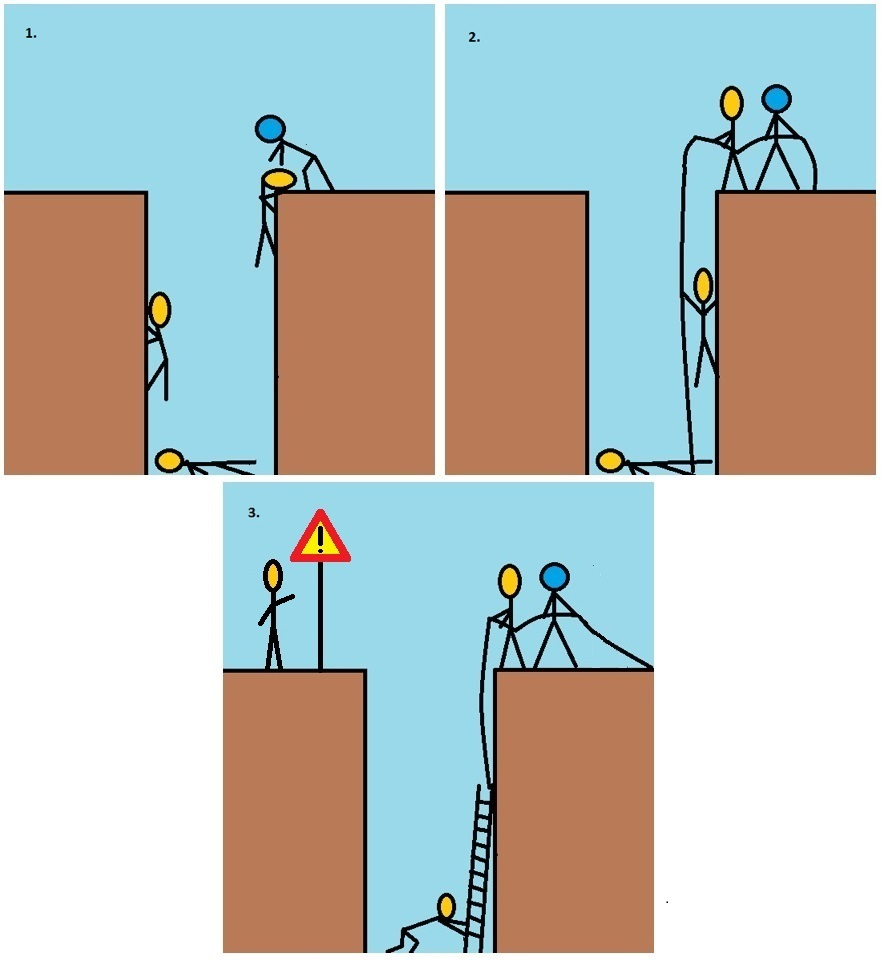
- “There are so many people who need my help. Let me help this person who is drifting on top. If I don’t help him, he may fall on the other guys and everyone will fall in the pit and crush each other.” (He first lifts the person who is drifting)
- “I’ll stand behind him and cover him up, so that he feels secured and not bothered about anything else while lifting others.” (He teaches others to lead and encourages to take bold steps)
- “I’ll ask them to leave this rope and ladder in the pit, and also to come up with ideas to avoid people falling in again.”(He seeks ideas from others)
The compassionate leaders are not blind to the social problems. They acquire great problem solving skills very early in life. They develop themselves to become great leaders very soon and very easily. They are passionate about making everyone a leader and compassionate about making everyone equal. They are ready to sacrifice anything for such cause.
When passionate people start looking at the world with more compassion they will find a million issues that need their immediate attention. By taking actions to address those issues they not only help the world to become better, they also help themselves to become better persons.
History has shown few successful leaders who turned out to be an exception to the passion-alone path. They eventually figure out that compassion is higher than the passion and became true leaders. Such is the case with Dr. A.P.J Abdul Kalam – The former President of India, who was a passionate rocket scientist popularly known as the ‘missile man of India’. On several occasions Dr. Kalam has mentioned that he learnt his lesson of compassion when he developed the lightweight calipers for polio-stricken kids — not when he developed military missiles. From then on he went to become the ‘Peoples’ President’ of India.
Even corporates can realign their goals with compassion to achieve a shared benefit for all its stakeholders and customers. When everyone starts choosing a purposeful less travelled path with compassion, everyone can lead a healthier, happier and prosperous life. Above all we will realize the true meaning of life and live it to the fullest.
The best way to find yourself is to lose yourself in the service of others.
~ Mahatma Gandhi